Understanding the Narrow Gate, the Difficult Road, and the Shepherd Who Comes Looking
By Jim Carmichael / Gold Cord Fellowship
I recently encountered this statement:
“If a person professes faith in Christ and yet falls away or makes no progress in godliness, it does not mean that he has lost his salvation. It reveals that he was never truly converted.”
That position takes a truth that applies to a limited condition and incorrectly makes it universal.
Certainly, anyone can claim to be a Christian without actually
being one.
Merely professing faith does not make someone a Christian.
But Scripture also describes people who genuinely came to Christ, received what God promised, and were then repeatedly warned not to fall away.
Those are two very different things.
And there is a third condition we must recognize: a Christian may genuinely believe, enter into salvation, and then stumble, sin, doubt, or experience a serious crisis of faith without actually repudiating Christ.
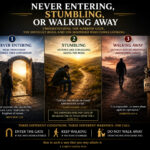
We must not confuse these three conditions:
Never entering, stumbling after entering, and deliberately walking away are not the same thing.
The Narrow Gate
Jesus said:
“Enter by the narrow gate; for wide is the gate and broad is the way that leads to destruction, and there are many who go in by it. Because narrow is the gate and difficult is the way which leads to life, and there are few who find it.” — Matthew 7:13–14
Notice that Jesus describes both a gate and a way.
There is an entrance, and then there is a road to travel.
The gate is narrow.
“Narrow” necessarily involves restriction. We do not decide for ourselves how we will enter God’s salvation. God establishes the conditions.
In that sense, salvation can be understood as an agreement or covenant. God establishes the covenant, makes the promise, and determines its conditions. Man chooses whether he will trust God and respond to those conditions.
Salvation begins with genuine belief in Jesus Christ. But genuine belief does not remain merely an intellectual claim. It produces a response.
We confess Jesus Christ as Lord. We recognize ourselves as sinful and lost. We confess and repent of our sins. We are baptized into Christ. God adds us to His church, and we receive the gift of the Holy Spirit.
We have entered through the gate.
But what happens if someone merely claims to have done so?
Never Entering the Gate
Imagine that I agree to purchase a car.
The seller agrees to sell it to me for a certain price, and I agree to pay that price.
But suppose I never complete my part of the agreement.
I never pay for the car.
I never receive the car.
I never receive the title.
I cannot later claim that I lost ownership of that car because I was never its owner.
That illustrates one possibility concerning someone who merely professes Christianity.
A person can call himself a Christian without ever genuinely believing and responding to God.
Jesus Himself warned:
“Not everyone who says to Me, ‘Lord, Lord,’ shall enter the kingdom of heaven…” — Matthew 7:21
A profession by itself proves nothing.
Such a person never entered the gate.
But suppose I actually complete the transaction for that car. I receive the car and its title. It genuinely becomes mine.
Years later, I sell it.
I am no longer its owner.
Would anyone reasonably argue:
“Since Jim doesn’t own that car today, that proves he never owned it”?
Of course not.
My present condition does not erase the reality of my previous condition.
And that is where we must listen very carefully to the language Scripture uses concerning those who fall away.
Entering the Gate
Scripture doesn’t merely describe people who claimed to possess salvation and subsequently disappeared.
Hebrews 6:4–6 describes people who:
“were once enlightened,”
“have tasted the heavenly gift,”
“have become partakers of the Holy Spirit,”
and
“have tasted the good word of God and the powers of the age to come.”
Then Scripture says:
“if they fall away…”
Read those words just as they are written.
The passage does not say:
“They only thought they were enlightened.”
It does not say:
“They pretended to taste the heavenly gift.”
It does not say:
“They claimed to be partakers of the Holy Spirit but actually weren’t.”
Scripture says they were enlightened, tasted the heavenly gift, became partakers of the Holy Spirit—and then describes the possibility of their falling away.
Hebrews 10:26–29 is equally forceful.
It describes someone who had “received the knowledge of the truth” and speaks of “the blood of the covenant by which he was sanctified.”
Then it describes the terrible consequences of deliberately rejecting what had been received.
Likewise, Galatians 5:4 says:
“You have become estranged from Christ…you have fallen from grace.”
Again, simply allow the words to speak.
Something cannot fall from a place where it never was.
If someone has fallen from grace, Scripture does not permit us simply to change that into:
“He was never actually in grace.”
That isn’t what the passage says.
But Entering the Gate Is Not the End
Jesus didn’t merely tell us about a narrow gate.
He said:
“Difficult is the way which leads to life.”
After entering the gate, there is a road to travel.
And Jesus warned us beforehand:
It is difficult.
Paul uses another illustration for the same principle—a race.
He wrote:
“Do you not know that those who run in a race all run, but one receives the prize? Run in such a way that you may obtain it.” — 1 Corinthians 9:24
There is a starting point.
There is a race.
There is a finish line.
And there is a prize.
Paul even applied the warning to himself:
“But I discipline my body and bring it into subjection, lest, when I have preached to others, I myself should become disqualified.” — 1 Corinthians 9:27
Paul wasn’t repeatedly warning Christians to continue, remain, endure, stand, hold fast, and finish merely to hear himself talk.
Warnings have meaning because there is something to be warned about.
Israel: The Example Paul Gave Us
Immediately after discussing his possibility of becoming disqualified, Paul points Christians to Israel.
They had passed through the sea.
They had been under the cloud.
They ate spiritual food.
They drank spiritual drink.
And Paul says:
“that Rock was Christ.” — 1 Corinthians 10:4
Nevertheless, many of them fell in the wilderness.
Then Paul explains why their story was preserved:
“Now all these things happened to them as examples, and they were written for our admonition…” — 1 Corinthians 10:11
Then comes the conclusion:
“Therefore let him who thinks he stands take heed lest he fall.” — 1 Corinthians 10:12
Read that like a child.
He stands.
Therefore:
Take heed lest he fall.
We should not change Paul’s statement into:
“He only thinks he stands, and if he falls, that proves he never actually stood.”
Paul could have said that.
He didn’t.
Instead, he warns the person who stands:
Do not fall.
But What About the Christian Who Stumbles?
Here we must be equally careful not to go beyond Scripture in the opposite direction.
If falling away is possible, does that mean every time a Christian sins he has lost his salvation?
No.
Does a period of doubt mean we have abandoned Christ?
No.
Does a crisis of faith mean we have fallen away?
No.
Consider Peter.
Peter denied Jesus Christ three times.
Yet Peter was restored.
Therefore, whatever Hebrews means by falling away, it cannot mean that every sin, failure, doubt, or even moment of denial automatically and permanently separates a Christian from Christ.
There is a tremendous difference between stumbling along the difficult road and deliberately abandoning the road.
The Bench Beside the Difficult Road
Imagine the narrow gate again.
You have entered it.
Ahead of you stretches the difficult road Jesus described.
You begin walking.
Some days are easier than others.
Then perhaps something terrible happens.
You suffer.
You become discouraged.
You encounter something you don’t understand.
Your faith becomes weak.
Perhaps you even begin questioning things you once thought were settled.
Alongside the road is a bench.
You sit down.
Maybe you sit there for a day.
Maybe for a month.
Maybe much longer.
You haven’t necessarily abandoned Christ.
You haven’t walked back through the gate.
You’re struggling.
You might be saying exactly what one man said to Jesus:
“Lord, I believe; help my unbelief!” — Mark 9:24
That man was struggling with belief.
Jesus did not reject him for admitting it.
So if you are sitting on that bench right now, don’t confuse your struggle with apostasy.
A crisis of faith is not necessarily the abandonment of faith.
And there is someone else on that road whom we must remember.
The Shepherd Who Comes Looking
Jesus said:
“What man of you, having a hundred sheep, if he loses one of them, does not leave the ninety-nine in the wilderness, and go after the one which is lost until he finds it?” — Luke 15:4
Notice:
“until he finds it.”
The Shepherd doesn’t say:
“That sheep wandered away. Apparently it was never really My sheep.”
He goes looking for it.
Matthew records Jesus saying:
“Even so it is not the will of your Father who is in heaven that one of these little ones should perish.” — Matthew 18:14
God does not give up on us because we stumbled.
He doesn’t abandon us because we’re having a terrible day.
He doesn’t stop loving us because we have questions.
He doesn’t look at the exhausted Christian sitting on the bench beside the difficult road and say:
“You stopped walking for a while, so you were never Mine.”
The Shepherd goes looking for His sheep.
That is very different from what Hebrews describes.
What Happens When We Deliberately Walk Away?
Now imagine something altogether different.
Instead of stumbling…
Instead of sitting down…
Instead of becoming lost…
A person deliberately turns around.
He walks back down the road.
He approaches the gate through which he entered.
And he knowingly rejects the Christ who saved him.
That is not:
“Lord, I believe; help my unbelief.”
That is repudiation.
Hebrews uses extraordinarily severe language to describe it.
Hebrews 6 speaks of those who fall away as:
“crucify[ing] again for themselves the Son of God, and put[ting] Him to an open shame.”
Hebrews 10:29 describes someone who:
“trampled the Son of God underfoot,”
treated as common “the blood of the covenant by which he was sanctified,”
and
“insulted the Spirit of grace.”
This is not merely a sheep stumbling.
This is turning against the Shepherd.
To put it in deliberately shocking human terms, it is the difference between falling down in front of someone who loves you and pulling a weapon on the person who came to rescue you.
One is weakness.
The other is repudiation.
And Scripture treats them very differently.
The Gate Has a Lock
In our illustration, imagine that the person deliberately walks back through the narrow gate, turns around, and rejects Christ.
The gate now has a lock.
And the key to that lock is faith.
The person originally entered because he believed Christ.
But now he has knowingly repudiated the very Christ through whom salvation came.
Hebrews 6:4–6 says concerning those who have received these things and then fall away that:
“it is impossible…to renew them again to repentance.”
Hebrews 10:26 says:
“there no longer remains a sacrifice for sins.”
Those are frightening words.
We should neither soften them nor explain them away.
The same Scripture that gives tremendous comfort to the struggling Christian gives a terrifying warning to the person considering deliberately abandoning Christ.
Three People — Three Different Conditions
We can now return to the statement with which we began:
“If a person professes faith in Christ and yet falls away…it reveals that he was never truly converted.”
That statement takes different conditions and attempts to make them all one.
Scripture does not.
Consider three people standing in relation to the narrow gate.
The First Never Entered
He may have called himself a Christian.
He may have attended church.
He may have known Christian language.
He may even have said, “Lord, Lord.”
But profession alone is not conversion.
He never entered the gate.
The Second Entered but Stumbled
He genuinely believed.
He entered through the gate.
He began walking the difficult road.
Then he stumbled.
Perhaps he sinned.
Perhaps he wandered.
Perhaps his faith became weak.
Perhaps he is presently sitting on our imaginary bench wondering whether he can continue.
But he has not repudiated Christ.
The Shepherd hasn’t abandoned him.
The Shepherd comes looking for wandering sheep.
He needs to repent where repentance is necessary, regain his footing, and continue walking.
The Third Entered and Later Walked Away
He genuinely received what God gave.
He was enlightened.
He tasted the heavenly gift.
He became a partaker of the Holy Spirit.
He was sanctified by the blood of the covenant.
But afterward he deliberately repudiated Christ and abandoned what he had received.
Scripture calls that falling away.
Those three people are not the same.
And we should not make them the same.
Don’t Add to the Warning — and Don’t Take Away From the Promise
There are two errors we need to avoid.
One is telling the struggling Christian:
“You stumbled, therefore God has rejected you.”
The Shepherd tells us otherwise.
But the opposite error is telling someone:
“You can deliberately reject Christ after receiving Him, and nothing has actually changed. If you truly belonged to Him, you can never leave.”
The warnings tell us otherwise.
We should neither add to Scripture nor take away from it.
Let the promise remain a promise.
Let the warning remain a warning.
Let the Shepherd seek the wandering sheep.
And let the words “take heed lest he fall” retain their force.
Keep Walking
There is a race because there is a finish line.
There is a warning because there is danger.
There is something to hold fast because it can be let go.
There is a narrow gate because not every road enters the kingdom.
There is a difficult road because entering the gate is not the end of the journey.
And there is a Shepherd because God knows His sheep sometimes wander.
So if you have never entered the gate:
Enter.
If you have stumbled:
Get up.
If you have sinned:
Repent.
If you are exhausted:
Rest for a moment, but don’t abandon the road.
If you are struggling with doubt:
Seek the truth and keep looking toward Christ.
If you have wandered:
Listen for the Shepherd who is looking for you.
And if you are considering deliberately turning your back on Christ:
Stop.
Listen to the warnings.
Do not abandon the One who saved you.
Do not walk back through the gate.
Do not throw away the key.
Never entering, stumbling, and walking away are three very different things.
And we should allow Scripture—not a theological system—to tell us the difference.
“Therefore let him who thinks he stands take heed lest he fall.” — 1 Corinthians 10:12
Jim Carmichael
Gold Cord Fellowship


Be First to Comment